
Is IPTV Legal in Canada? (2026 Guide)
If you're about to sign up for a streaming service, you've probably asked yourself: is IPTV legal in Canada? It's a fair question, and the honest answer is more nuanced than a simple yes or no.
The short version: IPTV technology itself is completely legal — it's just a method of delivering television over the internet. What matters is what is being streamed and whether the provider holds the rights to distribute it. In this guide, we'll break down exactly how that works, what separates a legitimate IPTV Canada service from a risky one, and what to look for before you subscribe.
Table of Contents
Is IPTV Legal in Canada? The Technology vs. The Content
To answer is IPTV legal in Canada properly, it helps to separate two things that often get confused: the delivery method and the content itself.
IPTV (Internet Protocol Television) is just a transmission standard — the same one used by many official cable and telecom providers in Canada today. Bell, Telus, and Rogers all deliver portions of their own TV service over IP networks. The technology is not the issue.
The real question is whether the company providing your channels has actually licensed them from broadcasters. A properly operated IPTV Canada subscription pays for the same distribution rights a cable company pays for — the channels just reach your screen through a different pipe.
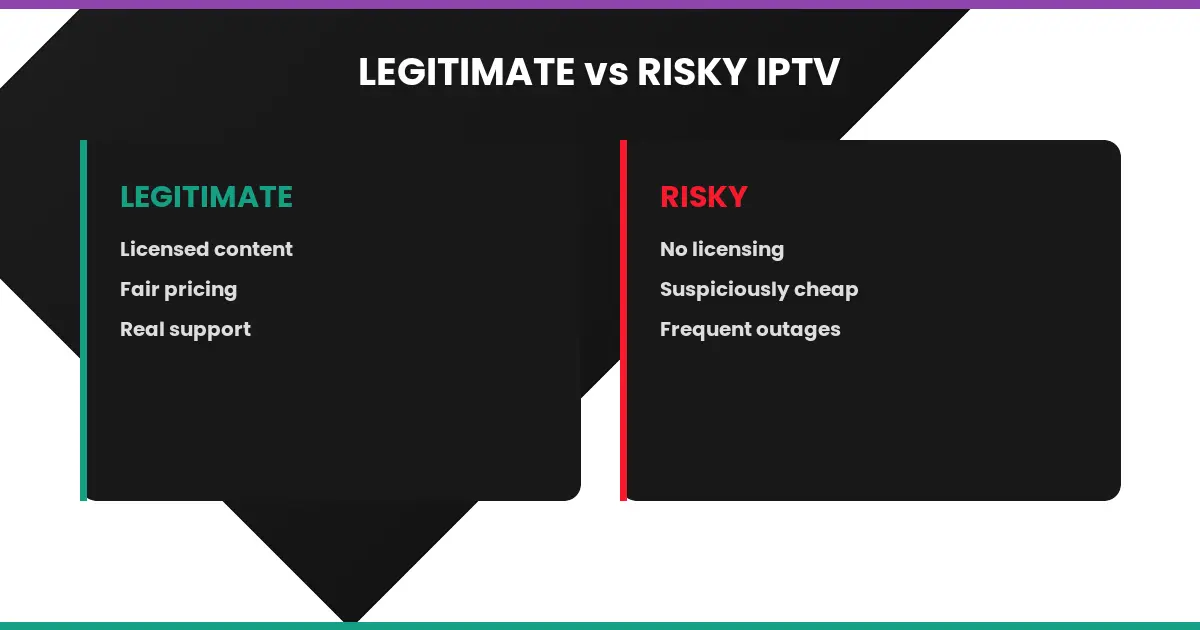
| Factor | Legitimate IPTV | Risky / Unlicensed IPTV |
|---|---|---|
| Content licensing | Paid broadcast agreements | No rights, pirated streams |
| Pricing | Comparable to cable | Unusually cheap, often lifetime deals |
| Transparency | Clear company, support, terms | Anonymous, no real support |
| Channel stability | Consistent uptime | Frequent takedowns and outages |
How to Tell If an IPTV Service Is Operating Legally
Since asking a provider directly rarely gets you a straight answer, it's more useful to check for a few practical signals yourself:
- The provider has a real, named business and a working support channel — not just a Telegram group.
- Pricing is reasonable and comparable to standard streaming or cable costs, not suspiciously low.
- Channels stay online consistently rather than disappearing every few weeks.
- The service offers a proper IPTV subscription Canada plan with clear terms, rather than vague "all channels forever" promises.
These same signals apply whether you're comparing services for sports, movies, or international channels — including our guide to watching NBA IPTV Canada or NFL IPTV Canada, where licensing quality directly affects whether the stream stays up during a live game.
What Canadian Law Actually Says
Canada's broadcasting framework is overseen by the CRTC, which regulates licensed broadcasters rather than individual streaming technologies. There is no law in Canada that bans IPTV as a category — the legal risk only applies to services that redistribute copyrighted content without permission from rights holders.
This is also why so many fans specifically search is IPTV legal in Canada before committing to a service — the line between a licensed reseller and a pirate stream isn't always obvious from the outside, and the two can look nearly identical in a player app.
Why Device Setup Doesn't Change the Legal Picture
Some people assume that using a specific device, like a Firestick or Android box, changes the legal status of what they're watching. It doesn't — the device is just a player. What matters is the subscription behind it. Whether you're streaming through a Firestick or Android box, a Smart TV, or a phone, the legality always comes down to whether your provider has proper content rights, not which hardware you used to connect.
Choosing a Legitimate IPTV Canada Provider
The safest approach is to treat an IPTV subscription the same way you'd treat choosing a cable or streaming provider: look for transparency, reasonable pricing, and consistent service. A properly run IPTV Canada provider will have real customer support, stable channel lineups, and clear subscription terms — all signs that point to a legally operating business rather than a short-lived reseller.
If you're comparing plans, the IPTV subscription Canada page breaks down exactly what's included at each tier, so you know what you're paying for before you commit.
Common Myths About IPTV Legality in Canada
A lot of confusion around whether IPTV is legal in Canada comes from a handful of persistent myths. The first is that IPTV is a single service — it isn't. "IPTV" describes a delivery method used by thousands of different providers, from major telecoms to small resellers, so lumping them all together under one legal verdict doesn't make sense.
The second myth is that a cheap price automatically means a service is illegal, or that an expensive one is automatically safe. Price is a useful warning sign, but it isn't proof either way — the real indicator is whether the provider can show it has actual distribution agreements in place.
The third myth is that VPN use implies guilt. Plenty of IPTV Canada subscribers use a VPN simply for general online privacy, the same reason they'd use one for banking or browsing — it has nothing to do with the legal status of the streaming service itself.